Fine dust in a culture dish
The skin question begins with an exposure, rather than a cosmetic finish.
The fine-dust experiment
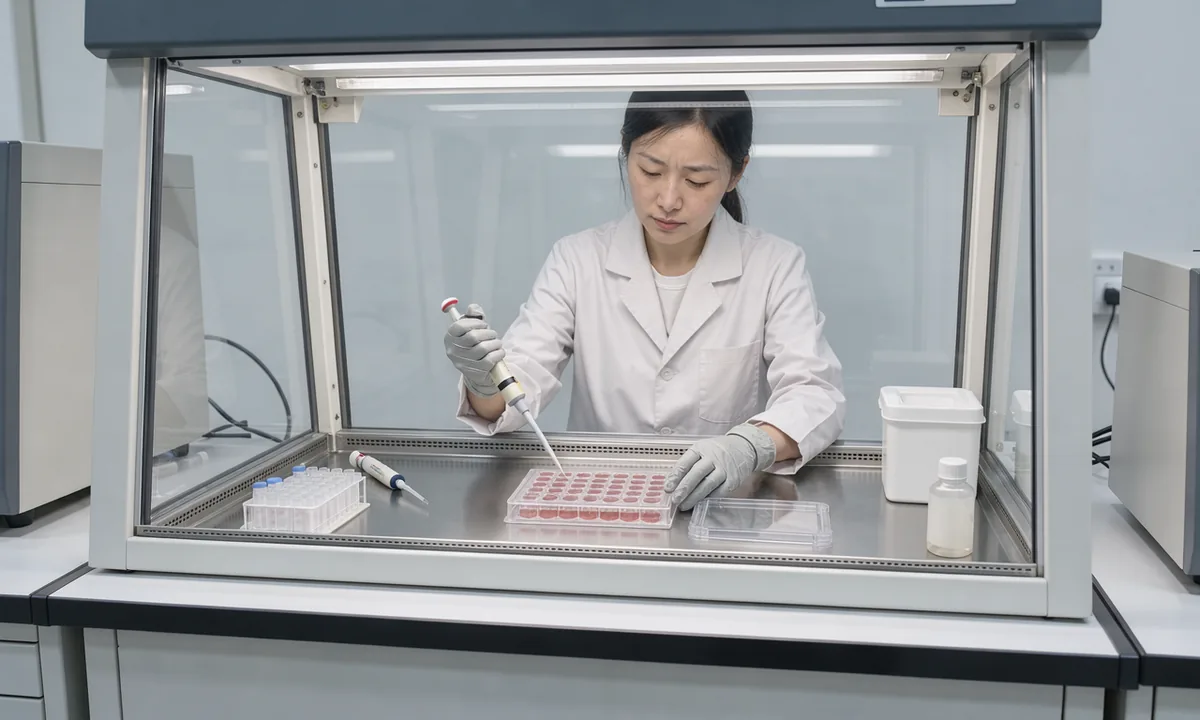
The title is unusually direct: Lysine-Proline-Valine peptide mitigates fine dust-induced keratinocyte apoptosis and inflammation. Published in 2025, it concerns human keratinocytes in vitro, meaning cells studied outside the body. KPV reduced particulate-matter-induced apoptosis and inflammatory signalling in those cells.
The pairing’s blunt vocabulary suits me: it takes injury seriously. A surviving cell and a reduced inflammatory signal are different observations, even when a paper puts them together. “Soothed” seems too soft a word for the injury being investigated. “Rejuvenated” imports a much broader ambition. I’d rather preserve the tougher vocabulary.
Dust and the language of beauty
Here the experimental setting is particulate matter applied to cultured human keratinocytes. The word “human” describes the cells. The study’s reported protective effects concern that system.
Dust sounds mundane; beside the word “apoptosis”, it becomes a rather different subject. For me, that shift outweighs the prospect of a prettier complexion. The ordinary nuisance and the cellular injury can occupy the same thought without an invented face cream coming to the rescue. I’m content to let the experiment end with exposed cells.
An environmental challenge brings cellular injury and inflammation into the same investigation. That question satisfies me on its own terms, even while the clinical possibilities remain questions.
The reported reduction in apoptosis and inflammatory signalling leaves me hoping for a future study with human participants, a specified preparation and outcomes such as discomfort, visible irritation and adverse effects. Those are questions I would bring to further research, rather than outcomes this cell experiment established.
I would also welcome an experiment that connects the cellular measurements to an observable skin change. Until then, I regard the fine-dust result as a promising investigation of a particular insult. The next essay, skin signals, looks at why the word “inflammation” still needs more precision even within the laboratory.